

Q1 2026 Outbound Sales Report: What We Learned From 100+ B2B Sales Teams
Here’s what actually worked in Q1 and what you should stop doing before Q2. Q1 always looks busy. More calls.More emails.More tools. But when we reviewed over 100 B2B sales teams, one pattern stood out: Activity went up. Results did not. That gap tells you everything. What Actually Worked in Q1 1. Fewer Leads. Better Conversations. The teams that performed best did less. Not less effort.Less waste. They focused on: Their pipelines looked smaller.Their close rates told a different story. If you want a practical breakdown, see how we approach qualified lead generation and appointment setting on our services page:👉 https://momentum-outbound.com/services 2. Timing Beat Personalisation Everyone is still talking about personalisation. But in Q1, timing won. A simple message sent at the right moment outperformed a perfect message sent too early. The best teams knew: They did not guess.They worked with signals. 3. Qualification Moved Upstream Top teams stopped qualifying on calls. They qualified before the meeting. That meant: So when the call started, it moved forward. Not sideways. If you want to see how this works step by step, here’s a simple breakdown:👉 https://momentum-outbound.com/how-it-works What You Should Stop Doing Before Q2 1. Stop Measuring Activity as Progress More emails does not mean more pipeline. More calls does not mean more revenue. If your team is busy but your numbers are flat,you do not have a volume problem. You have a qualification problem. 2. Stop Sending Reps Into Unqualified Calls This is where most teams lose time. The call starts.The rep asks basic questions.The deal weakens in real time. By the end, everyone knows it was not a real opportunity. That should never happen. 3. Stop Treating All Leads the Same Not every lead deserves attention now. Some are early.Some are not relevant.Some are simply not a fit. The best teams segment by: Everything else is noise. The One Shift That Changes Everything Across all 100+ teams, one shift made the difference: They moved from generating leads to qualifying opportunities. That sounds small. It is not. It changes: If you want a deeper industry breakdown, this guide is worth reading:👉 https://momentum-outbound.com/blog/qualified-leads-by-industry Final Thought Q1 proved something simple. Outbound does not fail because people are not trying.It fails because the wrong conversations are happening. Fix that, and everything else improves. One Line to Take Into Q2 If your pipeline needs to be qualified during the call, it was not built properly. External References For broader context on B2B buying behaviour and why timing matters, see:
How Remote BDR Teams Reduce CAC in High-Competition Markets (Energy, Telco & MSP Case Lens)

Introduction: Why CAC is Quietly Suffocating Growth Customer Acquisition Cost (CAC) has always mattered — but in 2025, it is now the defining pressure point across B2B commercial markets. Energy brokers are fighting shrinking margins and volatile acquisition costs.Telco account teams are battling price-sensitivity and shifting loyalty dynamics.MSPs are struggling with lead fatigue as prospects shop aggressively across providers. Whether you sell tariffs, connectivity, infrastructure, or managed IT services — you can feel it: Acquiring one customer is getting more expensive.More competitive.More operationally taxing.And ultimately, more unpredictable. The natural instinct is the traditional response: But in fiercely competitive markets, these “solutions” often inflate CAC instead of reducing it, because the true source of waste is not volume… …it’s inefficiency. It’s leakage. It’s misalignment. And increasingly, the answer is no longer more salespeople — but the right kind of sales capacity. Which is where remote BDR teams are quietly rewriting the economics. The CAC Fallacy: Volume ≠ Growth Most companies assume CAC comes from: But in reality, the biggest CAC drains are far less obvious: (1) Reps chasing the wrong personas (2) Too many meetings with non-buyers (3) Campaigns missing timing triggers (4) No intelligence layer behind outreach (5) Poor data hygiene (6) No continuity across pipeline efforts In Energy, this looks like:4 conversations to discover renewal dates, sometimes with the wrong contact entirely.Meaning more time, more labor, more waste. In Telco:Meetings without the bill-payer, or no bill copy collected — resulting in unquotable leads. In MSPs:Pipeline filled with “interested” prospects lacking budget allocation, systems alignment or technical urgency. These hidden costs bleed acquisition profitability long before close. And they are precisely what remote BDR teams fix. Why Remote BDR Teams Lower CAC — Mechanically, Financially & Strategically 1. They reduce the number of wasted conversations Not every meeting is valuable. Not every prospect is ready. Not every contact is the right buyer. Remote BDR teams specialise in pre-qualification, meaning your closers spend more time closing and less time filtering. Result:More qualified calendar timeFewer dead-end conversationsLower cost per revenue hour 2. They replace expensive roles with lower-cost high-output talent Hiring SDRs and BDRs internally is expensive. Salaries. Training. HR overhead. Infrastructure. Ramp time. Turnover. By contrast: A remote BDR pod =lower headcount costlower operational burdenfaster onboardinglower churn riskmore flexible scalability Cost Reduction vs In-House SDR: ≈ 60% – 70% average reduction That reduction flows directly into CAC improvement. 3. They solve the timing problem In competitive markets… timing matters more than messaging. Momentum-enabled BDRs use: Meaning they enter at the right window, not merely the earliest one. When timing improves, CAC follows. 4. They dramatically increase usable data density This is the hidden transformation. A great BDR team doesn’t only book meetings. They enrich pipeline intelligence. For Energy B2B: For Telco vendors: For MSP providers: This intelligence compresses CAC because: Sales doesn’t “search for truth.”They engage with clarity. 5. They stabilise pipeline velocity Internal sales teams frequently lose momentum due to managerial bandwidth limitations. Remote BDR teams anchor: daily researchdaily outbounddaily follow-updaily reportingdaily list hygiene Pipeline becomes reliable instead of seasonal. CAC, as a result, becomes predictable instead of reactive. Energy, Telco & MSP — The Strategic CAC Advantage Energy Your CAC decreases when your BDR team can: Because your closers stop chasing ghosts. Telco Your CAC drops when you reduce: In other words:less time researching, more time quoting. MSPs CAC shrinks when: This turns your sales team from explorers into surgeons. The Economic Equation: Why CAC Drops CAC improves because: Less waste + more timing accuracy + more data + lower cost seats + better qualification + continuous execution = cheaper acquisition And not theoretically. Operationally. Meaningfully. Visibly. The Human Layer That Makes It Work Remote BDR teams are not:templatedautomatedAI-replacing human reps They combine: AI precision + Human nuance + Operational consistency AI finds patterns.Humans build trust. That duality lowers CAC not by brute force… …but by strategic alignment. Conclusion: The Future of CAC Control Isn’t Internal — It’s Hybrid Companies who master the next wave of growth won’t: hire morespend morepush harder They will: deploy leaneroperate smarterqualify bettertime more preciselyreduce waste structurally Remote BDR teams provide that transformation. And in markets as fiercely contested as Energy, Telco, & MSP… that transformation isn’t optional. It is survival. If reducing CAC while increasing qualified pipeline is on your agenda this quarter… I’d like to show you what a remote BDR system looks like implemented inside real Energy, Telco & MSP operations. Share your preferred availability here: [Availability Form]Let’s discuss where CAC is silently leaking —and how to stop it at the source.
7 Forecasting Mistakes That Quietly Kill Your Quarter

The Quiet Collapse of Confidence Every sales leader has lived through it — that eerie moment in a quarter when everything on the dashboard looks perfect. The graphs curve upwards, the metrics align, and the team reports progress with conviction. On paper, it’s all momentum. But then, one by one, the deals that felt certain begin to wobble. Prospects stall. Budgets freeze. Conversations fade. Suddenly, the confident forecast that shaped board conversations and resource planning turns into fiction. It’s rarely a catastrophe that kills a quarter. It’s something smaller, quieter — a series of hidden forecasting errors that compound like hairline cracks beneath the surface. Activity that looks productive but leads nowhere. Conversion rates that no longer reflect reality. Optimism mistaken for certainty. The problem isn’t the tools or even the talent. It’s that sales forecasting, for all its spreadsheets and science, is a deeply human act. It reflects how your organisation thinks, what it values, and what it’s afraid to admit. When leaders start rewarding noise instead of nuance, the numbers begin lying — not maliciously, but faithfully, repeating the same hopeful mistakes that make us feel in control. The Mirage of Momentum In modern outbound culture, activity is easy to mistake for progress. Dashboards glow with metrics: calls made, emails sent, sequences completed, LinkedIn invites pending. The motion feels good — it satisfies the primal need to see movement. But activity is not momentum. It’s motion without direction. Many forecasts are built on the illusion that more outreach automatically means more pipeline. The truth is harsher. Without meaningful signals — buyer intent, engagement depth, timing relevance — you’re not measuring progress; you’re counting noise. Consider two teams: On a dashboard, Team A looks more productive. In reality, Team B is forecasting from truth, not movement. Momentum lives in relevance per interaction, not volume per rep. When leaders start measuring meetings per signal instead of calls per day, forecasting begins to reflect reality rather than effort. The difference isn’t philosophical — it’s financial. One approach builds clarity; the other burns time. When Yesterday’s Data Becomes Today’s Lie The second silent killer is outdated conversion data. Many companies still rely on stage-to-close ratios that haven’t been revisited in months, sometimes years. The logic is simple — if 25% of stage-three deals used to close, then 25% still should. But markets evolve faster than reporting systems do. Buyer committees expand, new decision-makers enter, pricing pressures change, and competitor behaviour shifts constantly. If your forecast depends on last year’s data, it’s already inaccurate before the quarter begins. This is the illusion of consistency — mistaking familiar numbers for reliable ones. A living forecast needs living data. It should be recalibrated every month, not quarterly. Modern forecasting should integrate dynamic variables such as: When you blend these layers, your forecasts stop repeating history and start predicting behaviour. The accuracy gap between static and adaptive forecasting isn’t marginal — it’s transformative. The Weight of the Wrong Deals Not all pipeline is created equal, yet many forecasts pretend it is.A £10,000 pilot with an untested prospect and a £250,000 enterprise renewal shouldn’t carry equal weight in the same forecast. Still, that’s exactly how most CRMs treat them — as identical rows in a spreadsheet. When leaders look at aggregated pipeline numbers, they see volume, not validity. The problem is that unsegmented pipeline data hides risk. A forecast can look healthy while being built on opportunities that were never likely to close. The simplest fix is brutal honesty through segmentation. Classify every deal into tiers based on Ideal Customer Profile (ICP) fit and maturity: This exercise often shrinks your pipeline, but it expands your truth. It’s better to have a smaller, believable forecast than a larger illusion. When boards and investors start trusting your numbers again, you’ll realise accuracy is the most valuable currency a sales leader owns. The Timing Trap: When Signals Arrive Too Soon Forecasts fail not only because of bad data, but because of mistimed interpretation.Signals are real — but they don’t always mean “now.” A spike in website visits after a webinar might not mature into interest for six weeks. A competitor trial signal might take two quarters before the prospect is ready to switch. Many teams treat signals as immediate sales triggers, when in fact they’re early indicators of future movement. This mismatch creates what we call signal lag — the time between interest detected and action taken. Building signal lag into your forecast changes everything. You begin to understand pacing. You stop chasing leads too early and start aligning outreach with natural buying rhythm. It’s not just more humane — it’s more accurate. Outbound should mirror timing, not manipulate it. The Seduction of Overconfidence Optimism is essential to sales, but fatal to forecasting.A rep convinced that “this one’s a sure thing” will inflate probability. A manager eager to show momentum will defend it. Soon, an entire leadership team is forecasting from belief instead of evidence. This overconfidence bias turns forecasting into storytelling — compelling, but wrong. The solution isn’t cynicism; it’s calibration. Teach your team to weigh confidence the same way they weigh deal size. Every forecasted deal should carry two scores: Over time, comparing these scores creates forecasting maturity. You learn which instincts are accurate and which are aspirational. The process transforms forecasting from fiction to foresight. The Decay of Early-Stage Opportunities Late-stage deals get attention because they’re visible, urgent, and exciting. But most leakage in a forecast happens long before the deal reaches that point.Early-stage opportunities sit untouched, gathering digital dust. They’re still listed in the CRM, still marked as active, still inflating the pipeline. But they’re dead. Ignoring these opportunities creates false comfort. You believe your pipeline is strong because it’s full — when in truth, half of it expired quietly. Instituting an early-stage decay audit changes that.Every 14 days, review deals with no engagement.Re-engage or remove them.You’ll lose lines from your forecast spreadsheet, but gain something more valuable — accuracy. Forecasting isn’t just predicting wins;
Hybrid Intelligence at Work: Where AI Ends and Human Judgment Begins

The Quiet Shift That’s Redefining Work For years, we were told AI would replace us.Now, we’re seeing something more nuanced — it’s redefining us. Across GTM teams from outbound to marketing and enablement — AI isn’t just making tasks faster; it’s changing how we think about work itself. It’s filtering the noise, amplifying context, and forcing every professional to ask: “What’s left for the human when the machine can do everything faster?” The answer?Everything that still requires awareness, empathy, and reasoning. The End of Efficiency as a Competitive Edge For decades, “efficiency” was the holy grail.Fewer meetings. Faster outreach.More automation. More dashboards. AI supercharged that philosophy and suddenly, everyone had the same tools.But when everyone can automate, efficiency loses its edge. The true differentiator now?Judgment. The ability to choose which problems deserve solving.To sense when a signal is just noise.To connect raw data to human intent. That’s the quiet skill that will separate thriving teams from automated mediocrity. Where AI Ends: Context, Nuance, and the “Why” AI can tell you what happened and even what might happen next.But it can’t tell you why it matters. Every GTM motion still needs something deeply human: These small judgments are what transform automation into trust.They don’t scale easily but that’s exactly why they matter. Hybrid Intelligence: Humans + Machines in Motion In 2025, the strongest GTM teams are not fully automated.They’re hybrid where machines handle repetition and humans handle reasoning. Function AI’s Role Human Role Prospecting Identify in-market accounts using live signals and competitor intercepts. Select accounts that deserve engagement based on context and narrative. Outreach Generate personalised messaging from ICP data. Edit for authenticity and empathy — the “human filter.” Forecasting Predict probabilities and pipeline velocity. Interpret anomalies and make judgment calls beyond data. Reporting Automate dashboards and KPI tracking. Turn data into stories and insight. Customer Success Monitor tone, automate follow-ups, flag churn signals. Intervene with empathy, retain through real conversation. The goal isn’t “humans vs. machines.”It’s humans with machines each performing at their natural strength. The RACI Model for AI-Empowered GTM Teams To keep accountability intact in hybrid workflows, the RACI model still works, just redefined for AI: This structure ensures the thinking stays human, even when the doing becomes automated. Prompt Libraries: The New Playbooks AI runs on language, not logic.And the teams building shared prompt libraries are already outperforming those who rely on scattered experimentation. Why? Because great prompts are not hacks, they’re systems for consistent thinking. Imagine a central “Prompt Hub” where: Prompt libraries don’t just scale productivity, they scale judgment.They become the new playbooks that evolve with your people. Quality Loops: The Hidden Advantage AI doesn’t get smarter on its own.It learns through feedback; the same way humans do. Winning teams treat their AI systems like apprentices: These quality loops build trust not just in data, but in decision-making.Without them, AI becomes a megaphone for mediocrity. The Human Edge: Attention In a world that automates almost everything, attention is the new currency. You can automate outreach. You can even automate decision trees.But you can’t automate focus. The teams that win aren’t the ones who send the most, they’re the ones who notice the small things:a buyer’s hesitation, a subtle tone shift, an unspoken need. Attention is what makes human judgment priceless and irreplaceable. Final Thought AI has made work faster.But only humans can make work meaningful. The future isn’t “AI-powered.”It’s human-aware. Because somewhere between automation and intuition lies the real competitive advantage:judgment. Build a Smarter Pipeline Momentum Outbound’s Pipeline-as-a-Service blends live buying signals, human context, and measurable results.It’s not just automation — it’s hybrid intelligence for revenue teams. 👉 Learn how it works
Cold Calling in the Age of AI: Why Human Conversations Still Win

The Debate That Won’t Go Away If you spend time in sales circles right now, you’ll hear two competing narratives: Neither is true. What’s really happening is more nuanced and more important for business leaders to understand. AI-generated cold calls, better known as robocalls, are being banned worldwide. At the same time, human-to-human cold calling remains not only legal, but one of the most effective ways to reach new customers when it’s done well. The future isn’t about replacing humans with machines. It’s about enabling humans with better tools. 🚫 The Global Ban on AI Cold Calls Across major markets, regulators have drawn a line: Key takeaway: In most developed markets, using an AI voice for outbound prospecting is either illegal or heavily restricted. ⚠️ The Risks Businesses Can’t Ignore The penalties aren’t theoretical. But fines aren’t the only cost. There’s also brand damage: once prospects associate your business with intrusive robocalls, you’ve lost trust before you even begin. 🤝 Why Human SDRs Are the Answer So where does this leave outbound teams? With humans, but smarter. At Momentum Outbound, we’ve pioneered what we call Enabled SDRs. They’re not just callers. They’re trained, structured professionals supported by AI-driven research, data enrichment, and sequencing tools. That means: Technology powers the structure, but people build the connection. 🌟 Compliance as a Competitive Advantage Instead of fearing regulation, forward-thinking leaders are using it to stand out. While competitors waste time with risky robo-dialling, you can scale an outbound engine that’s: In 2025 and beyond, the winners will be the teams that embrace the human-first, tech-enabled model. 🔗 The Momentum Outbound Difference We don’t gamble with compliance. We build outbound systems where: Cold calling isn’t dead. It’s evolving. And Momentum Outbound is here to make sure you stay ahead of the curve. 📩 Book a consultation with our team to see how compliant, human-first outbound can drive your next wave of growth.
Momentum Outbound Wins Double Recognition at the 2025 Greater London Enterprise Awards
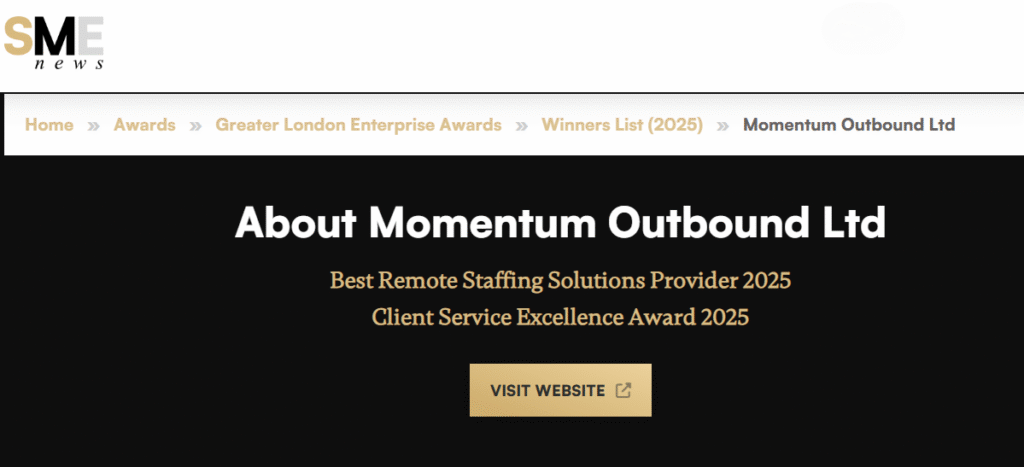
Celebrating a Milestone for Remote Staffing Excellence Momentum Outbound is proud to announce a double win at the 2025 Greater London Enterprise Awards, receiving both the Best Remote Staffing Solutions Provider 2025 and the Client Service Excellence Award 2025. This recognition underscores our mission: to deliver not just remote teams, but measurable outcomes that transform how companies scale. About the Awards Now in their ninth year, the Greater London Enterprise Awards spotlight the region’s most impactful SMEs—businesses shaping industries through innovation, resilience, and outstanding service. Winners are chosen purely on merit, distinguishing those that demonstrate exceptional ingenuity and lasting value to clients and communities. Why Momentum Outbound Stood Out At Momentum, we believe remote staffing isn’t a “stopgap” solution—it’s a strategic growth engine. We’ve helped clients across the UK, US, and beyond to: The Client Service Excellence Award reflects our dedication to partnership. We don’t just provide people—we deliver systems, culture-fit, and accountability that make remote teams thrive. A Word from Our Leadership “These awards are a recognition of both our clients and our teams worldwide,” said Ben Hewitt, Co-Founder of Momentum Outbound. “We’ve always believed remote staffing should empower businesses, not burden them. This recognition validates our approach of combining global talent with structured support to accelerate growth.” Looking Ahead Momentum Outbound will continue to build on this momentum by expanding access to global talent markets, investing in next-generation team performance systems, and ensuring that every client feels the impact of remote staffing done right. We’re not just building teams.We’re building the future of work. Learn More To explore how our award-winning remote staffing solutions can accelerate your business growth, visit:👉 https://momentum-outbound.com
Outsourced SDR Services: How External Sales Teams Accelerate Your Revenue Growth

Introduction Scaling revenue has never been more complex. Buyers are harder to reach, sales cycles are longer, and decision-makers are flooded with pitches every day. For growing companies, building a high-performing outbound engine is a make-or-break challenge. This is where outsourced SDR services step in. By leveraging external sales teams, businesses can accelerate pipeline growth, reduce costs, and focus their in-house talent on closing deals instead of chasing them. But how exactly do outsourced SDRs work and why are they becoming the go-to growth strategy for companies across industries? Let’s break it down. What Are Outsourced SDR Services? Sales Development Representatives (SDRs) are responsible for the top of your funnel: prospecting, outreach, qualification, and booking meetings for your closers. With outsourced SDR services, instead of hiring, training, and managing these roles internally, you partner with an external provider who delivers: The result? You get a fully operational outbound sales engine without the heavy upfront investment or the risk of bad hires. The Business Case for Outsourced SDR Services 1. Faster Ramp-Up Times Hiring SDRs internally can take months—sourcing, interviewing, onboarding, and training. With an outsourced team, you skip the learning curve. Experienced SDRs hit the ground running, often booking meetings within weeks. 2. Cost Efficiency An in-house SDR in the UK can cost upwards of £50,000 annually once you factor in salary, benefits, tools, and overhead. Outsourced SDR services often operate at 40–60% of that cost while providing infrastructure and management baked in. 3. Access to Expertise Good SDR management is rare. Outsourced providers specialise in outbound strategy, meaning you gain access to: 4. Scalability on Demand Need to double your outreach capacity for a new product launch or market entry? With outsourced SDR services, you can scale up or down without the HR headaches. 5. Focus on Closing, Not Chasing Your Account Executives (AEs) shouldn’t be spending hours cold calling or sending sequences. When outsourced SDRs handle prospecting, your internal team can focus on what they do best—closing deals and growing accounts. How Outsourced SDR Services Drive Revenue Growth Building Consistent Pipeline Outsourced SDRs work full-time on top-of-funnel activity, ensuring you never face the “feast or famine” cycle of sporadic outreach. A steady pipeline creates predictable revenue. Targeting the Right Accounts Modern outsourced providers use data-driven ICP (Ideal Customer Profile) building and advanced prospecting tools. This ensures SDRs aren’t just booking more meetings—they’re booking the right ones. Shortening Sales Cycles When your AEs only engage with pre-qualified, sales-ready leads, they close faster. This shortens sales cycles and improves conversion rates across the funnel. Enabling Market Expansion Want to test a new region or industry? Instead of gambling internal resources, outsourced SDR services give you a low-risk entry point to validate markets with targeted campaigns. Choosing the Right Outsourced SDR Partner Not all outsourced SDR services are created equal. Here’s what to look for: A strong partner should feel like an extension of your team, not a disconnected agency. Is Outsourcing SDRs Right for You? Ask yourself: If the answer is yes to any of these, then outsourced SDR services could be the accelerator your sales engine needs. Conclusion Outsourced SDR services are no longer just a stopgap solution for startups. They’re a proven growth lever for companies of all sizes—reducing costs, improving efficiency, and accelerating revenue.By combining external expertise with your internal closers, you create a sales machine that’s scalable, predictable, and focused on what matters: closing deals and driving growth.
We Audited 100 Remote Hires: Here’s What the Top 10% Did Differently

Momentum Outbound Original Research & Executive Hiring Blueprint Executive Summary Not all remote hires are created equal. Since our launch in January 2025, we’ve placed more than 100 remote professionals across sales, operations, marketing, customer support, and admin functions. After working closely with our client partners to review their onboarding journeys and performance data, we identified a core truth: The top 10% of remote hires delivered 2x to 3x more business value than the average. In this report, we break down exactly what made them different. No fluff, no recycled hiring advice. Just actionable patterns, proof points, and practical tools for founders, COOs, and hiring leaders building high-performing global teams. This is more than a blog post. It’s your Remote Hiring Toolkit. Why This Audit Was Necessary Remote hiring is no longer a novelty. It’s the norm. But here’s the uncomfortable reality: Most remote hires underperform. Not because they’re unskilled.Not because they’re unqualified.But because the system around their hiring, onboarding, and integration is broken. We built this audit to: The Audit: Methodology & Scope Sample Size: 118 remote hires placed by Momentum Outbound (January to July 2025) Functions Covered: Industries: SaaS, eCommerce, Fintech, Digital Services, Recruitment Data Sources: Success Metric: Time-to-impact, manager satisfaction score, documentation quality, and independent ownership What the Top 10% Did Differently These were not marginal gains. The top performers didn’t just complete tasks. They amplified operations. 1. They Took Ownership, Not Instructions 2. They Documented Their Own Workflows 3. They Gave Managers Confidence 4. They Operated Asynchronously By Default 5. They Cared About the Business, Not Just the Role 6. They Scaled Themselves What Their Onboarding Looked Like Across every top 10% performer, we saw consistent onboarding milestones: Timeframe Actions Taken Day 1 Assigned a real outcome, not a task list Week 1 Shadow sessions, full systems access, async culture primer Day 10 Delivered independent project or report By 30 Days Wrote/refined SOP for their process By 60 Days Suggested and implemented improvement Ongoing Shared weekly async updates, took ownership of outcomes These weren’t complex rituals. They were small, intentional behaviours that multiplied results. Where the Bottom 50% Struggled The difference wasn’t IQ. It was approach. Common patterns among underperformers: Many were capable. But the lack of ownership mindset made them high-effort, low-impact team members. What This Means for Your Hiring Strategy This audit revealed a sobering truth: Hiring for remote performance requires different signals than local hiring. You don’t just want someone with the right CV. You want someone with: These traits often don’t show up in standard interviews. Your Remote Hiring Checklist Use this checklist in your next remote hiring cycle: Interview Signals: Red Flags: Onboarding Actions: How Momentum Integrates This Learning Our updated vetting now prioritises: We don’t just match skills. We vet for impact habits. Every candidate we present has been screened for: Final Word to Founders, COOs & Hiring Leaders You don’t need more people. You need the right remote professionals. The best hires multiply time, not just fill seats. If you’re scaling across time zones, functions, or markets—we’ve already done the heavy lifting. Download the Full Remote Hiring Toolkit This report is just the beginning. Our Remote Hiring Toolkit includes: [Download now →] Ready to Meet a Top 10% Remote Candidate? We spotlight our best pre-vetted professionals every week.They’re ready. They’re vetted. They’re outcome-driven. [View Our Momentum Pre-Vetted Candidates →]
Outsourcing for Social Impact (CSR): How Remote Teams Can Power Purpose-Led Growth

Rethinking Outsourcing: From Cost Centre to Change Maker Outsourcing has long been seen as a cost-cutting tool. But forward-thinking UK businesses are redefining it as something more powerful: a force for social impact. In 2025, it’s not just about offloading admin. It’s about building global capability — while supporting inclusive employment, economic development, and digital equity in underrepresented regions. At Momentum Outbound, we’ve seen firsthand how remote teams can accelerate business growth and social good simultaneously. What Is Outsourcing for Social Impact? “Outsourcing for social impact” means partnering with talent providers or remote teams in a way that intentionally creates positive outcomes for people, communities, and the environment. This includes: “Every offshore hire is an opportunity — not just for your business, but for someone’s future.” 5 Ways Remote Teams Drive Social Impact 1. Empowering Youth in Emerging Markets In countries like Nigeria, Kenya, and the Philippines, highly educated young professionals often lack access to global career pathways. By outsourcing admin, customer support, marketing, or tech roles to these regions, UK companies provide: ➡️ One of Momentum’s client teams in Scotland supports over 3 remote employees whom are first-time remote workers earning above national averages. 2. Creating Inclusive Hiring Pipelines Many traditional hiring models unintentionally exclude talent — especially caregivers, neurodiverse individuals, or those outside major cities. Remote outsourcing opens doors to: Inclusion isn’t just a box to tick. It’s a productivity unlock. 3. Building Economic Resilience in Local Communities When global companies invest in remote workers from developing economies, the ripple effect is real: According to the World Bank, a 10% increase in outsourcing to low-income economies increases GDP growth by up to 1.4%. 4. Driving Sustainable Employment Outsourcing doesn’t have to mean short-term contracts or burnout culture. With the right partner, you can create: At Momentum Outbound, we design team structures that support retention and upward mobility, not just plug-and-play task-doers. 5. Aligning With ESG and CSR Goals Investors, employees, and consumers increasingly expect companies to prove their impact — not just state it. By embedding social impact into your global hiring strategy, you: The Business Case: Doing Good = Growing Stronger Ethical outsourcing doesn’t just feel good, it’s a smart business strategy. Companies that prioritise social impact often see: The future of work is not local. It’s global, inclusive, and intentional. How to Outsource with Social Impact in Mind Here’s how your company can start: ✅ Step 1: Choose a partner aligned with ethical sourcing Not all outsourcing firms prioritise worker wellbeing. Vet your provider’s: Momentum Outbound builds long-term, supported remote teams not gig workers on a spreadsheet. ✅ Step 2: Build growth and impact KPIs Track both business results and social outcomes: ✅ Step 3: Share the story Highlight your impact in: People want to work with businesses doing good. Show them how you’re doing it. Real Impact, Not Just Outsourcing At Momentum Outbound, we don’t just build teams.We build global opportunity pipelines rooted in dignity, career growth, and shared success. By choosing remote team architecture that prioritises people, you don’t just save on cost.You gain purpose, loyalty, and a story that outlasts quarterly reports. Want to See How It Works? We’ve helped 100+ companies scale remote teams and support global communities in the process. 👉 See how we build purpose-led teams 📥 Or download our Remote Hiring Kit to start your journey.
New Launch: Why 250+ Business Leaders Subscribed to Our LinkedIn Newsletter on Day One

There’s a reason over 250 UK-based founders, COOs, operations leaders and talents subscribed to our LinkedIn newsletter, Momentum Monthly, in the first 24 hours. Because we’re not just sharing updates;We’re breaking down what actually works when you’re trying to scale operations without breaking your team or blowing your margins. Think: This isn’t fluffy thought leadership. It’s real, tested strategy from the engine room of B2B scale. Built for:→ SaaS and tech founders→ Heads of Operations and Growth→ Talent leaders tired of reactive hiring→ UK companies building global remote teams 📬 Subscribe now to catch the next issue:👉 Momentum Monthly on LinkedIn We write for the decision-makers; the ones asking better questions about cost efficiency, lean growth, and global execution.If that’s you?We’ve got a seat saved.