

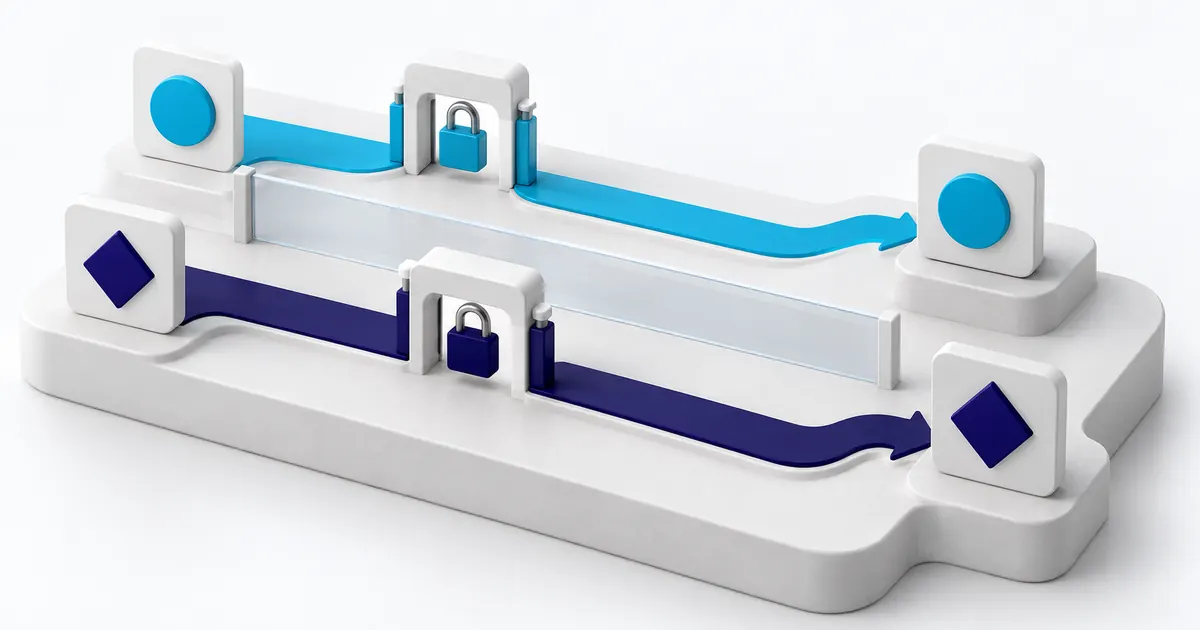
A reply for one brand reaches the team running another. A shared contact record appears in the wrong campaign. The tools are connected, but the boundaries between the businesses are unclear.
Multi-brand workflow automation can support separate processes within shared infrastructure where the systems allow it. It requires explicit rules for brand identity, permissions, ownership and information movement.
Adding a brand label to a record is a useful start. It is not, by itself, a complete separation design.
Carry brand identity through the whole process
Establish how the brand is identified when information enters: perhaps through a particular form, mailbox or approved campaign reference. Keep that identity attached as the request moves into the CRM, task system and reports.
Do not rely on a person recognising the brand from the wording of a message. Define what happens if the source is missing or conflicts with the existing record.
For uncertain cases, route the item to review rather than guessing which team should own it.
Decide what should be shared and what should stay separate
Some information may legitimately be shared across teams; other information may need restricted access. Write those boundaries down before configuring the workflow.
For example, a hypothetical group might share approved company reference data while keeping each brand’s opportunities, messages and owners separate. Another group may require completely separate records or workspaces.
The appropriate design depends on business requirements and what the tools can enforce. A filtered view is not equivalent to an access restriction: confirm actual permissions rather than assuming a hidden record is inaccessible.
Make contact restrictions explicit
Define which exclusions apply across the whole organisation and which apply to a particular brand or process. The workflow should carry the agreed restrictions through imports, updates and routing.
Do not silently interpret a restriction as narrower or broader than the policy your team has agreed. Ambiguous cases need an owner who can resolve them.
This is also why duplicate handling needs care. Combining records should not erase a relevant restriction or transfer information into a brand context where it does not belong.
Route replies to an accountable owner
A reply needs both the correct brand context and someone responsible for the next action. Agree whether ownership follows an existing account, the originating campaign or a defined team rule.
Include a fallback for absent owners and unexpected replies. Keep the original message and relevant source reference available so the reviewer can understand why it entered that route.
If an acknowledgement or draft is prepared, check that it uses the correct brand identity. Internal routing accuracy and customer-facing identity are separate things to test.
Test separation with deliberate cross-brand examples
Use examples that challenge the boundaries: the same person appearing under two brands, a missing brand field, a restricted user opening a record and a reply arriving through the wrong mailbox.
Check reports too. A combined management view may be appropriate for some users while individual teams need their own view. Reporting permissions should reflect those responsibilities.
Also test what happens after a record is updated or merged. Separation needs to remain intact throughout the record’s life, not only when it is first created.
Begin with a clear scope
Document the brands, tools, shared information, access boundaries and owners before deciding how to connect them. Where a platform cannot enforce the required separation, the design needs to change.
Momentum Outbound can include brand separation, campaign rules and reply routing within commercial infrastructure, where required and technically supported. Start with a process review to establish the connections and controls your organisation needs.