
Your BDR just spent 90 minutes on a discovery call.
The prospect seemed engaged. They asked good questions. They said they’d “circle back next week.” But three follow-ups later, you realise the truth: they were never going to buy. Wrong budget. Wrong authority. Wrong timing. Wrong everything.
That wasn’t just a lost opportunity. That was £187 in wasted salary, 90 minutes your team will never get back, and one more chip taken out of your BDR’s confidence.
Bad leads aren’t harmless. They don’t just “not convert.” They actively drain your business—stealing time, destroying morale, and bleeding revenue in ways most sales leaders never calculate.
Here’s what unqualified pipeline is actually costing you.
Table of Contents
- What Makes a Lead “Bad”?
- The Real Cost: Breaking Down the Numbers
- Time Theft: The Invisible Drain
- The Morale Tax: When Your Team Stops Believing
- Revenue Impact: Beyond the Lost Deal
- How Bad Leads Enter Your Pipeline
- The Qualification Standards That Actually Work
- What Energy Brokers, MSPs, Telecoms, and Merchant Services Get Wrong
- The 5-Minute Qualification Framework
- How to Audit Your Current Pipeline
- What to Do With Leads Already in Your System
- Common Objections (And Why They’re Wrong)
- FAQs
- Take Action
What Makes a Lead “Bad”?
A bad lead isn’t someone who said no. It’s someone who was never qualified to say yes.
Here’s what that looks like in practice:
Wrong contact: You’re speaking to someone who can’t approve, sign, or influence the decision. An office manager when you need the owner. A junior IT technician when you need the IT Director.
Wrong timing: Their contract doesn’t expire for 18 months. They renewed last week. They’re mid-implementation with a competitor. There’s no active buying window.
Wrong context: You don’t know their current setup, contract terms, or pain points. You’re guessing what they need instead of qualifying what they have.
Wrong fit: They’re outside your ICP. Too small, too large, wrong sector, wrong geography. You can’t serve them well even if they buy.
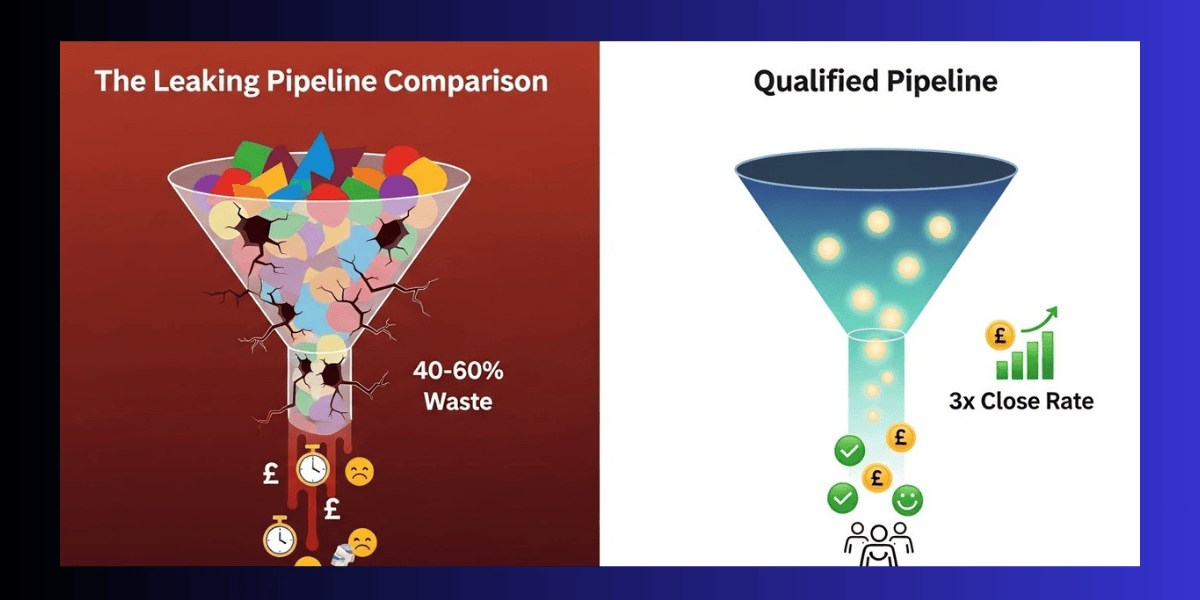
These aren’t edge cases. For most sales teams, 40–60% of pipeline falls into at least one of these categories.
And every single one of them is costing you more than you think.
The Real Cost: Breaking Down the Numbers
Let’s assume your BDR earns £35,000 per year. That’s roughly £17 per hour (assuming 2,080 working hours annually).
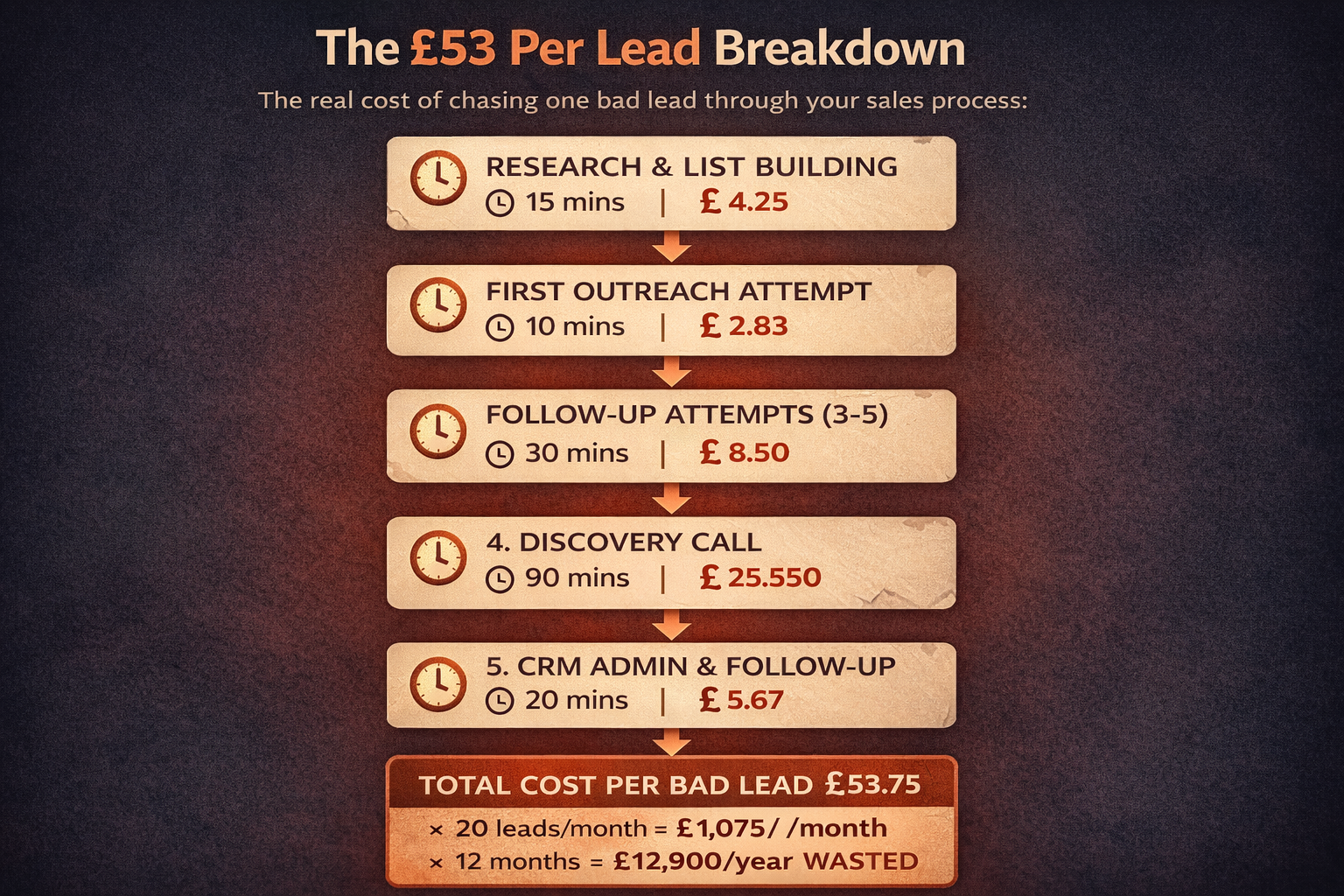
Here’s what one bad lead costs:
Initial research and list building: 15 minutes = £4.25
First outreach attempt (email/call prep): 10 minutes = £2.83
Follow-up attempts (3–5 touches): 30 minutes = £8.50
Discovery call (if you get that far): 60–90 minutes = £17–£25.50
Internal follow-up and CRM admin: 20 minutes = £5.67
Manager review time: 15 minutes = £7.50 (at £30/hour)
Total cost per bad lead that reaches discovery: £45.75–£53.75
Now multiply that by 20 bad leads per month.
That’s £915–£1,075 in wasted salary every single month. Over a year, that’s £10,980–£12,900 going directly into a black hole.
And that’s just one BDR. If you’re running a team of five, you’re looking at £54,900–£64,500 annually in wasted payroll alone.
But the salary cost is actually the smallest part of the damage.
Time Theft: The Invisible Drain
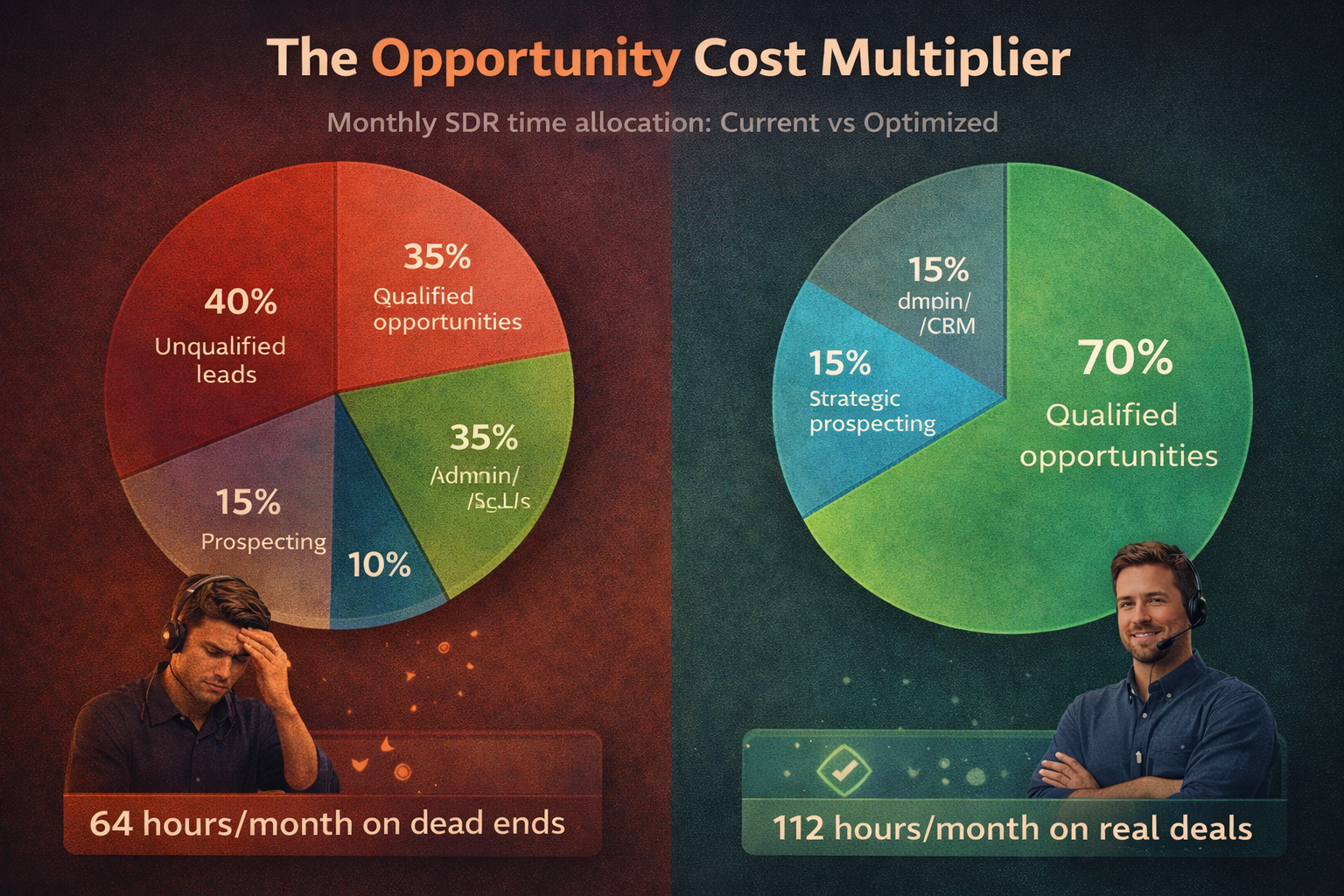
Bad leads don’t just waste time. They steal opportunity cost.
Every hour your BDR spends chasing an unqualified prospect is an hour they’re not spending on a real opportunity. That’s the hidden multiplier most sales leaders miss.
Your BDR has 160 working hours per month. If 40% of their pipeline is unqualified, they’re spending 64 hours per month on leads that will never close. That’s 1.6 full working weeks every single month producing zero revenue.
Now consider what they could be doing with that time:
- 30 additional calls with properly qualified prospects
- Deeper discovery on high-intent accounts
- Relationship building with decision-makers who can actually buy
- Targeted follow-up on warm opportunities
The opportunity cost isn’t just the wasted time. It’s the revenue you didn’t generate because your team was busy with the wrong people.
The Morale Tax: When Your Team Stops Believing
This is where bad leads do their most insidious damage.
When your BDR spends two weeks nurturing a “hot lead” only to discover the prospect has no budget, no authority, and no intent, something breaks. Not immediately. But gradually.
They start to distrust the pipeline. They stop believing their own qualification. They become cynical about every conversation. And worst of all, they start cutting corners because “it probably won’t close anyway.”
The morale tax compounds over time:
- Lower activity levels (why bother if it’s all rubbish?)
- Shorter discovery calls (just get through it)
- Weaker qualification (what’s the point?)
- Higher attrition (good reps leave first)
One MSP owner told us his best BDR quit after six months because “I’m tired of being set up to fail.” The pipeline looked healthy on paper. But 70% of it was garbage, and the rep knew it before management did.
You can’t measure morale in a spreadsheet. But you can see it in turnover rates, sick days, and the quality of conversations your team is having.
Bad leads don’t just waste time. They erode belief.
Revenue Impact: Beyond the Lost Deal
Sales leaders often think about bad leads in terms of “deals we didn’t close.” But the revenue impact is much larger than that.
Here’s what bad pipeline actually costs:
1. Forecasting failure: Your board thinks you’ve got £400K in pipeline. But £240K of it is junk. So you miss targets, lose credibility, and make poor hiring or investment decisions based on phantom revenue.
2. Delayed good leads: Real opportunities sit in the queue while your team chases dead ends. By the time you circle back, they’ve already signed with a competitor.
3. Reputation damage: Every bad-fit conversation you force burns a potential relationship. That procurement manager you cold-called six months too early? They remember. And they’re not taking your call when the timing is actually right.
4. Higher CAC: If 50% of your pipeline is unqualified, your actual cost per acquisition is double what you think it is. You’re spending twice as much to close half as many deals.
5. Weaker negotiating position: When your team is desperate to hit quota and the pipeline is thin (because most of it is rubbish), you discount harder, accept worse terms, and give away margin you shouldn’t.
Bad leads don’t just fail to generate revenue. They actively sabotage the revenue you could have generated.
How Bad Leads Enter Your Pipeline
Most unqualified leads come from one of five sources:
1. Bought lists: Generic databases with outdated contacts, wrong job titles, and zero intent signals. You’re calling people who’ve never heard of you and don’t care.
2. Inbound with no qualification: Someone downloaded a whitepaper or filled a form. But that doesn’t mean they’re ready to buy, have budget, or hold authority. Your team assumes interest = intent.
3. Loose lead scoring: Your CRM gives points for email opens, page visits, and engagement metrics. But none of that tells you if they can actually buy.
4. Volume-first BDRs: Your team is measured on activity (calls made, emails sent) rather than quality. So they pump weak leads into the pipeline to hit targets.
5. Optimistic qualification: “They seemed interested” becomes “hot lead.” Your BDR wants to believe it’s real, so they skip the hard questions about authority, budget, and timing.
The problem isn’t always the source. It’s the lack of qualification before leads enter the pipeline.
The Qualification Standards That Actually Work
Here’s what proper qualification looks like—whether you’re selling energy contracts, telecom services, IT support, or merchant processing:
Authority: Are you speaking to someone who can approve the purchase? Not influence. Not recommend. Approve.
Timing: When does their current contract end? When do they need to make a decision? Is there an active buying window, or are you 12 months too early?
Context: What’s their current setup? Who’s their current provider? What are the terms? What’s working, what isn’t? You can’t position value without this.
Fit: Do they match your ICP? Can you actually serve them well? Or are you trying to force a square peg into a round hole?
If you can’t answer all four with confidence, it’s not a qualified lead. It’s a guess.
And guesses are expensive.
What Energy Brokers, MSPs, Telecoms, and Merchant Services Get Wrong
Each vertical has its own qualification blind spots. Here’s what we see most often:
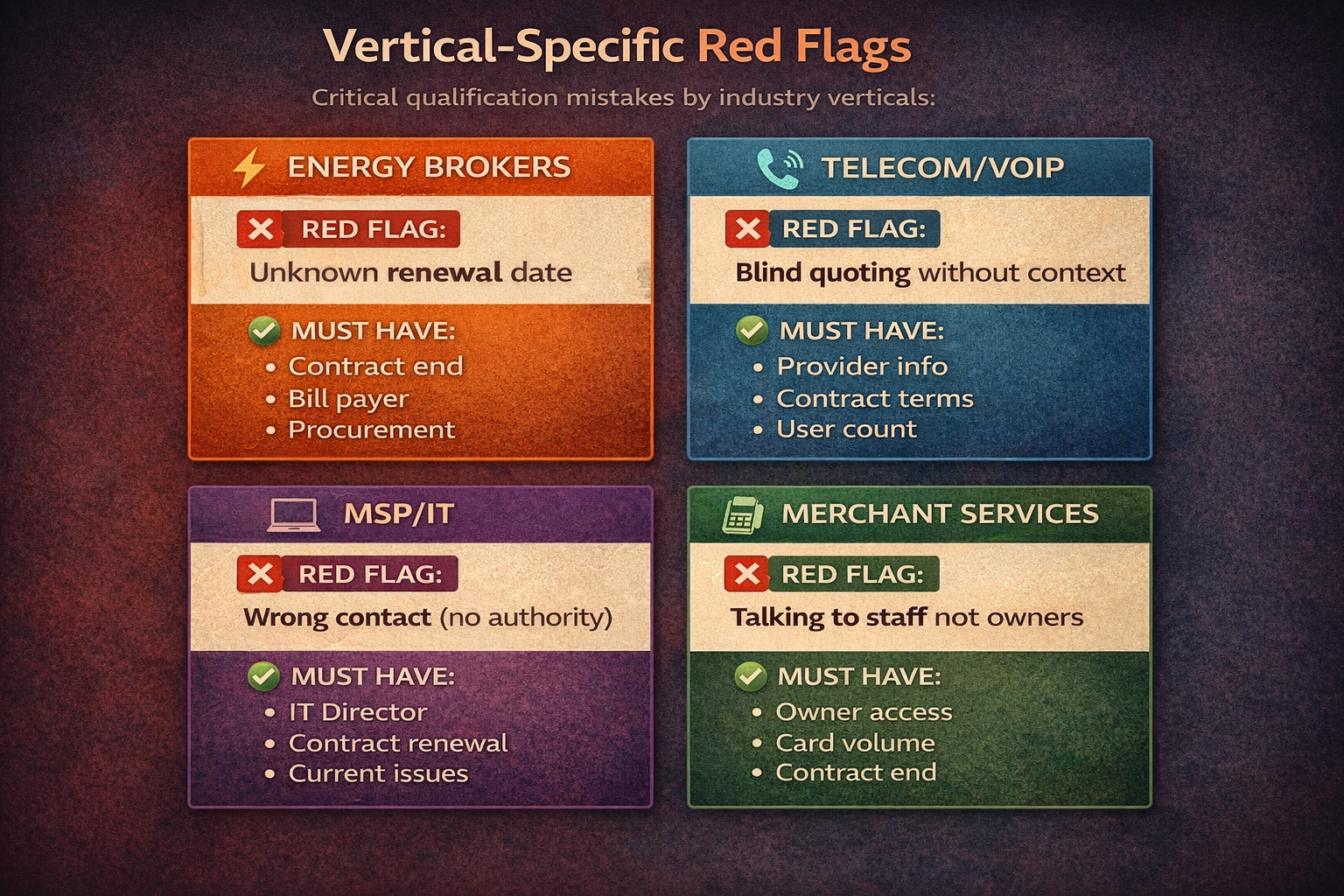
Energy Brokers
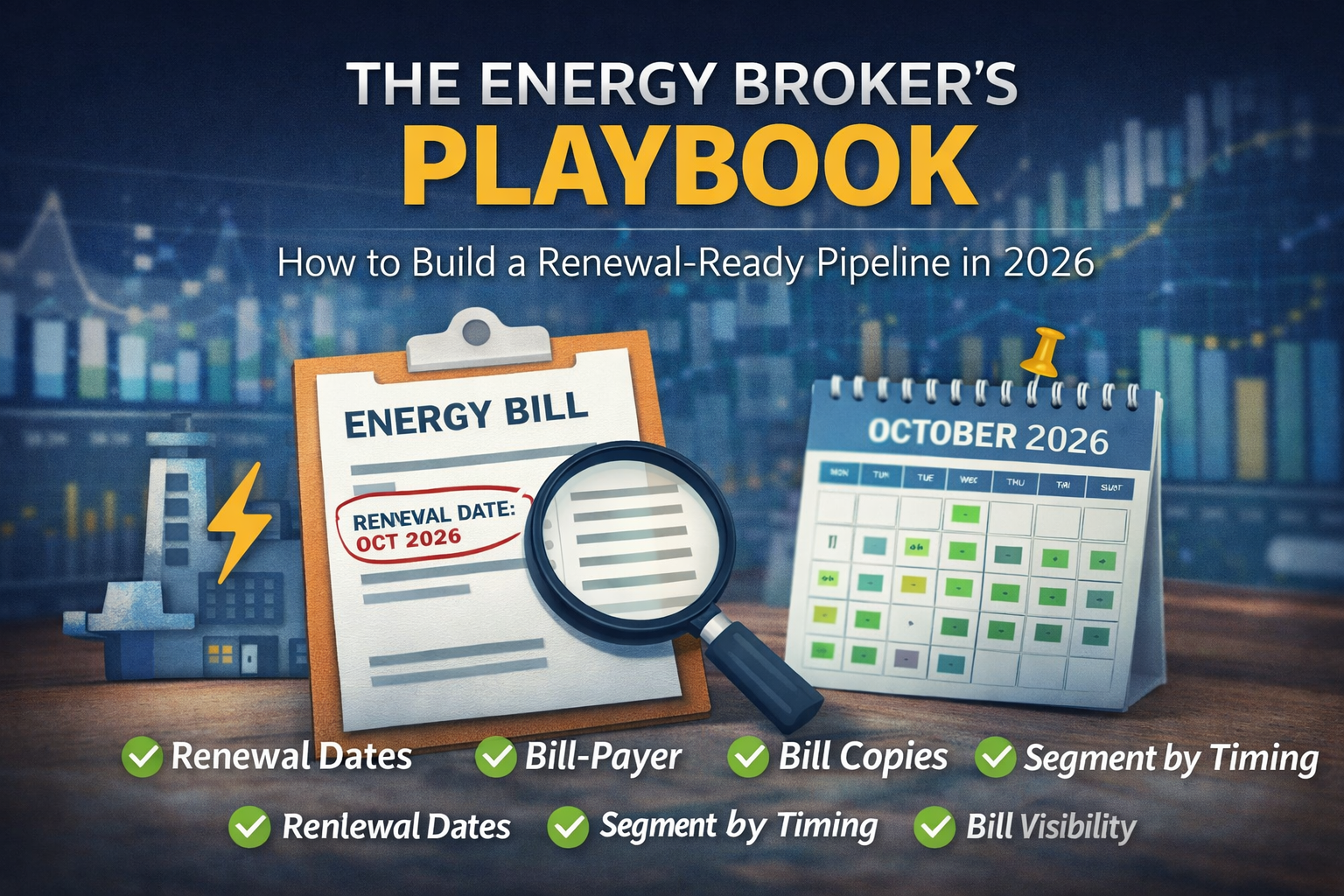
The mistake: Chasing companies without knowing renewal dates or speaking to the wrong person (office manager, not procurement).
The fix: Don’t touch a lead unless you know: (1) contract renewal date, (2) who handles energy procurement, (3) current supplier and rates. If you’re missing any of these, you’re guessing.
Telecom / VoIP
The mistake: Quoting blindly without understanding current provider, contract end date, or technical requirements.
The fix: Qualify: (1) current provider and contract terms, (2) number of users/lines, (3) connectivity type, (4) decision-maker access. Without this, you’re pitching into a void.
MSP / IT Services
The mistake: Long discovery calls with users or junior IT staff who can’t approve anything. Wasting weeks on “interested” contacts who lack authority.
The fix: Qualify upfront: (1) Who’s the IT Director or equivalent? (2) When does current support contract renew? (3) What’s prompting the conversation? No authority = no pipeline.
Merchant Services / EPOS
The mistake: Talking to staff instead of owners. Not knowing transaction volume or contract position.
The fix: Speak only to owners or decision-makers. Qualify: (1) monthly card volume, (2) current processor and rates, (3) contract end date. Volume and authority are non-negotiable.
The 5-Minute Qualification Framework
Use this at the start of every conversation:
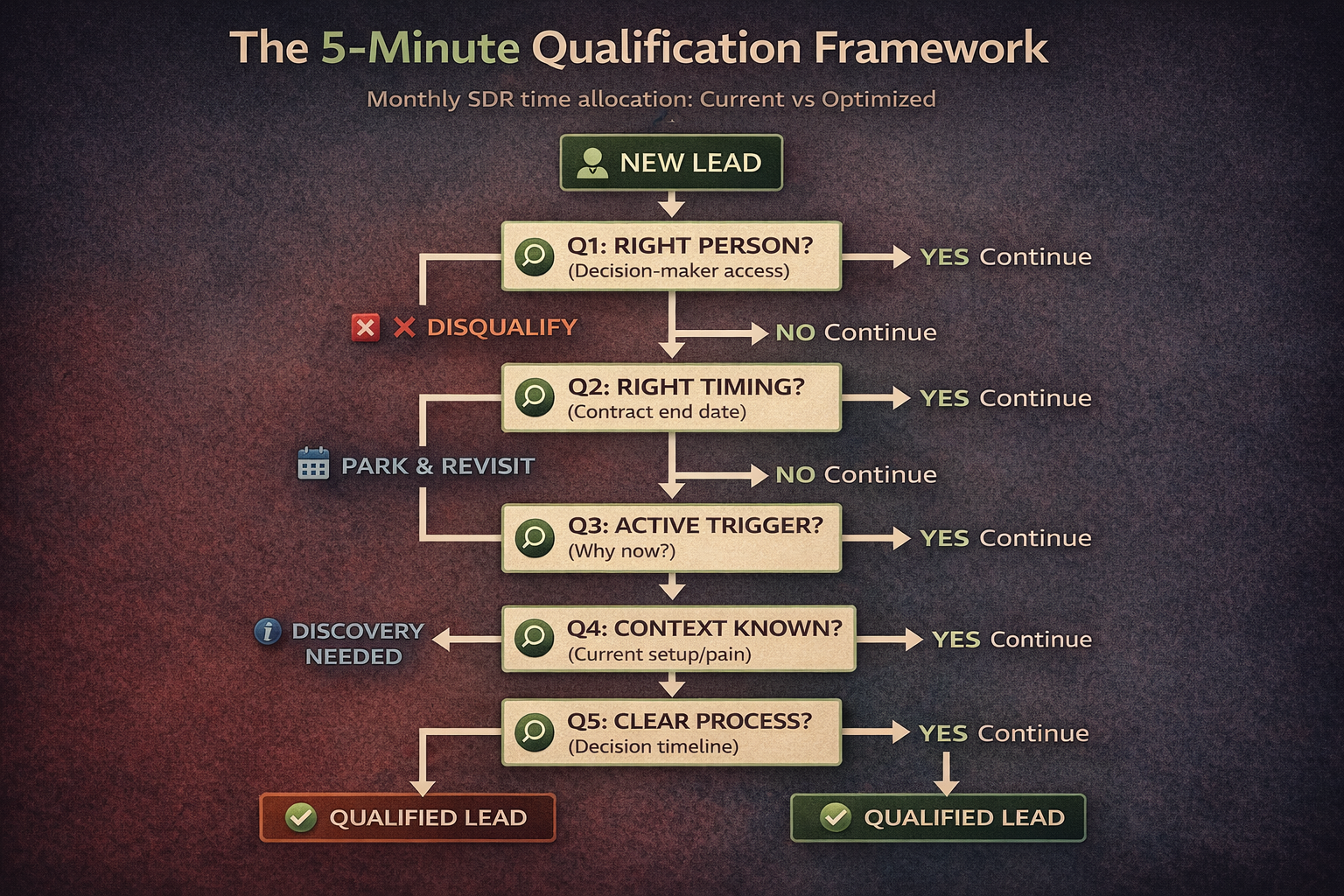
Question 1: “Who handles [energy procurement / IT decisions / telecom / card processing] at your company?”
(This tells you if you’re speaking to the right person.)
Question 2: “When does your current [contract / agreement / support term] end?”
(This tells you timing and urgency.)
Question 3: “What prompted you to [take this call / look into alternatives / respond]?”
(This tells you intent and triggers.)
Question 4: “What’s working well with your current setup, and what isn’t?”
(This tells you context and pain points.)
Question 5: “If we find a better fit, what’s your decision process and timeline?”
(This tells you how deals get done internally.)
Five questions. Five minutes. If you can’t get clear answers, you don’t have a qualified lead.
How to Audit Your Current Pipeline
Pull up your CRM right now. Go through every open opportunity and ask:
- Do I know the decision-maker’s name and role?
- Do I know when their contract ends (or buying window opens)?
- Do I know their current setup and pain points?
- Have I confirmed they fit our ICP?
- Have I spoken directly to someone with authority?
If the answer to any of these is “no” or “not sure,” that lead is unqualified.
Mark it. Deprioritise it. Or disqualify it entirely.
Most teams discover 40–60% of their pipeline fails this test. That’s not a problem with the audit. That’s the problem you’ve been ignoring.
What to Do With Leads Already in Your System
You’ve got three options:
Option 1: Re-qualify immediately.
Reach out with the 5-minute framework. Get the missing information. If you can’t, move to Option 2.
Option 2: Deprioritise and revisit later.
If timing is wrong (contract ends in 18 months), park it. Set a reminder for 90 days before renewal. Don’t waste cycles now.
Option 3: Disqualify and move on.
If they don’t fit your ICP, you can’t reach the decision-maker, or there’s no active buying window, cut them. Freeing up mental space for real opportunities is more valuable than clinging to phantom pipeline.
Be ruthless. Your team’s time is finite. Treat it that way.
Common Objections (And Why They’re Wrong)
“But we need the pipeline numbers for board meetings.”
Phantom pipeline is worse than no pipeline. It creates false confidence, poor forecasting, and bad decisions. Better to know the truth.
“If we disqualify too much, we’ll have nothing left.”
Good. That’s the wake-up call you need. A small pipeline of real opportunities outperforms a bloated list of maybes every single time.
“Our reps will push back on stricter qualification.”
Short-term pain, long-term gain. Reps who’ve been chasing rubbish for months will thank you once they’re working real deals.
“What if we disqualify someone who could have converted?”
Possible. But the cost of chasing 100 unqualified leads to catch 2 edge cases is far higher than the value of those 2 deals.
FAQs
How much pipeline should I expect to disqualify?
Most teams find 40–60% of current pipeline doesn’t meet proper qualification standards. If you’re below 30%, you’re either exceptionally disciplined or not being honest.
What’s a realistic qualification rate for new leads?
Depends on source. Inbound should qualify at 20–30%. Outbound done well should qualify at 10–15%. Bought lists? 2–5%.
How do I get my team to embrace stricter qualification?
Show them the cost analysis. Walk through their current pipeline and highlight time wasted. Once they see it, most reps want higher standards.
Should I still track activity metrics?
Yes, but add qualification rate and pipeline quality metrics. Activity without quality is just noise.
What if our lead source is the problem?
Then fix the source. Stop buying lists. Invest in trigger-based outbound. Build signal intelligence. If the tap is poisoned, turning it up won’t help.
How often should I audit pipeline quality?
Monthly at minimum. Weekly is better. Make it a standing agenda item in pipeline reviews.
Can I use automation to filter bad leads earlier?
Partially. You can filter by ICP fit, company size, and sector. But authority, timing, and intent require human qualification.
What’s the ROI of better qualification?
Teams that implement strict qualification see 30–50% improvement in close rates, 20–40% reduction in sales cycle length, and significantly better forecasting accuracy within 60–90 days.
Take Action
Bad leads are expensive. Not in obvious ways, but in the slow, compounding drain on time, morale, and revenue that most sales leaders don’t calculate until it’s too late.
You can keep pretending your pipeline is healthy. Or you can audit it, disqualify the rubbish, and rebuild around leads that actually convert.
The choice isn’t between “some pipeline” and “no pipeline.” It’s between phantom pipeline that drains your team and real pipeline that generates revenue.
If you’re ready to see what proper qualification looks like—and how signal-led, trigger-based outbound delivers decision-maker access, timing intelligence, and contract context from day one—download the Pipeline Quality Audit Checklist.
It’s a one-page framework that walks you through the exact questions to ask, the red flags to watch for, and the standards top teams use to protect their time and close more deals.